
Bill Brown ... Xiamen University
"Love your neighbor as yourself." Jesus (Luke 10:27b)
"Most people try to find themselves outside themselves. They seek fulfillment through work, wealth and status. Then eventually that route takes them to despair, in which their souls are broken. Only as their souls break do they turn upward to God, and then can see the way to the calm waters of his peace." Soren Kierkegaard (1813-1855).
"Love yourself as your neighbor." To love ourselves as our neighbor is not narcissism but a logical necessity if we are to obey Christ's command to love our neighbor as ourselves. If we don't love what our Father has made of us, we can't love our neighbor--we can only resent our neighbor as we resent ourselves. But given the frenzy with which our paparazzi populace follows the lives of the rich and famous, or the rich and famous wannabes on American Idol, it seems that most people are not that keen on themselves, much less on others.
The folks on the cover of People Magazine do seem to have it all--until you look a bit closer. The media that places them on a pedestal even more eagerly kicks them off it, and revels in airing their misery before the world as these falling stars cope with broken marriages, addictions, failure. Some give up altogether and take their own lives--though by then their life is no longer their own anyway.
Plastic Britneys. Ever notice the change in folks as they move up the ladder? I remember the first photo of Britney Spears that I saw. She was an innocent looking, smiling teen in jeans. Then the music industry gave her a make-over and within a couple years she was a pouting, anoxeric, gyrating blonde sex symbol with the same moves and sounds as half a dozen other pop stars--and she didn't seem that happy about it.
To Be, or to Pretend to Be. The world may not be clamoring to become like you and me, but at least we are something that the plastic pop icons cannot be: we are 100% unique, and winners from day one (we are the product of the 1-in-500 million sperm cells that made it to the egg first). We started out unique, and then our Father placed each of us in unique environments to mold us for unique purposes. We each have unique abilities to build upon, and unique weaknesses to overcome and learn from. Our "success", and true happiness, lie not in simply emulating others (though we can learn from them) but in discovering the unique purpose for which we were created, and then having the patience to allow our Father to mold us to achieve that purpose. As Confucius wrote,
"Rare is he who after 3 years of study does not already want to be an official." [三年学,不至於谷,不易得也]
One Body, Many Parts Jesus own disciples, James and John, asked to be elevated above the other apostles and to sit at his side (Mark 10:27). And in the earliest days of the New Testament church, distinctions and divisions arose over who was "important" and who was not. But in 1 Corinthians 12:12-27, Paul addressed this with a brilliant analogy, saying that a body has many parts but all are necessary because each is unique, and does something that no other part can do. As Paul said in verse 19, what would the body be if it were all one part--all one big foot, or hand, or--horrors--one big mouth!
It would have been a boring world, for our Father and us, if his children were all simply cookie cutter copies. Fortunately, we are each a Hand-signed Heart-felt original. And when we can appreciate how uniquely our Father made us, and love ourselves not for what we have made of ourselves but for what our Father has made of us, and is making of us, then we can love others as we love ourselves. Until then, we are simply resenting others as we resent ourselves.
1 Corinthians 12:12-27 One Body, Many Parts
1Co 12:12 The body is a unit, though it is made up of many parts; and though all its parts are many, they form one body. So it is with Christ.
1Co 12:13 For we were all baptized by one Spirit into one body—whether Jews or Greeks, slave or free—and we were all given the one Spirit to drink.
1Co 12:14 Now the body is not made up of one part but of many.
1Co 12:15 If the foot should say, "Because I am not a hand, I do not belong to the body," it would not for that reason cease to be part of the body.
1Co 12:16 And if the ear should say, "Because I am not an eye, I do not belong to the body," it would not for that reason cease to be part of the body.
1Co 12:17 If the whole body were an eye, where would the sense of hearing be? If the whole body were an ear, where would the sense of smell be?
1Co 12:18 But in fact God has arranged the parts in the body, every one of them, just as he wanted them to be.
1Co 12:19 If they were all one part, where would the body be?
1Co 12:20 As it is, there are many parts, but one body.
1Co 12:21 The eye cannot say to the hand, "I don't need you!" And the head cannot say to the feet, "I don't need you!"
1Co 12:22 On the contrary, those parts of the body that seem to be weaker are indispensable,
1Co 12:23 and the parts that we think are less honorable we treat with special honor. And the parts that are unpresentable are treated with special modesty,
1Co 12:24 while our presentable parts need no special treatment. But God has combined the members of the body and has given greater honor to the parts that lacked it,
1Co 12:25 so that there should be no division in the body, but that its parts should have equal concern for each other.
1Co 12:26 If one part suffers, every part suffers with it; if one part is honored, every part rejoices with it.
1Co 12:27 Now you are the body of Christ, and each one of you is a part of it.
www.amoymagic.com
Monday, April 6, 2009


Sunday, April 5, 2009
Fahrenheit 140
Bill Brown ... Xiamen University
"He who has ears to hear, let him hear." Matthew 11:15 NAS
"Am I going to do a good deed? Then, of all times--Father, into thy hands, lest the enemy should have me now." George MacDonald
A few days ago I reread Ray Bradbury's classic book Fahrenheit 451, in which firemen don't extinguish fires but create them. Their primary task is burning books, which for years went unread, and then were banned after the government realized the advantages of leading an unthinking, docile populace. Paper, by the way, catches fire at 451 degrees Fahrenheit, hence the name of the book. But given time, slow cookers can cook meat (and brains) at as low as 140 degrees....
America does not need to ban books because, as in Fahrenheit 451, book reading is a dying art. In August 2007, the Washington Post reported that in 2006, 27% of Americans did not read even one book (and 43% did not read a book in 2002). Many Americans do not read because they cannot read. Fully 1 in 5--21%--of Americans are "functionally illiterate", and the figure is 36% for Washington D.C. (perhaps because so many residents are members of congress?).
People are not only reading less but thinking less. They simply soak in whatever they are fed by TV and the internet. Even with the economic difficulties, we are still relatively comfortable and complacent, like a frog in a pot of slowly boiling water (meat, and brains too, I suppose, can cook at only 160 degrees). We're trusting that Obama or the G20 or the Z40 or someone will get us back on track--but was that the right track in the first place?
Actually, we're not on a track but a river, and it is raging towards a precipice, but we can't see it when we're floating on our backs, eyes shut, basking in the sun, brains cooking slowly. We need to raise our heads, open our eyes, and look about us!
Jesus said, "He who has eyes to see, let him see." With global news 24/7, and the internet at our fingertips, it's easier than ever to see what is going on around us, but we don't have to read news from the ends of the earth. Just a look at our own homes, neighborhoods and towns will tell us that, even in so-called good times, the current is carrying us in a direction that we really do not want to go.
Though individually we probably can't change the course of the river, we don't have to just flow with it.We need to think for ourselves, and pray for inner guidance, wisdom and discernment. Of course, the moment we try to slow down, or swim to the side, we feel the pressure of those about us to get back in line, to conform--to put our brains back in neutral and trust that Big Brother will take care of things. But Big Brother is as powerless as we are.
"To lead an uninstructed people to war is to throw them away." [子曰:“以不教民战,是谓弃之。”] Confucius
If a great oak tree is rotten to the core, we can prop up its branches but it will still topple. In the same way, if our nation's people are empty and mindless, without purpose or direction (other than being consumers to keep everything going), we can prop up the country economically and politically but it will still topple, and the enemy is not North Korea, Afghanistan or Iran but ourselves.
Today, I'll read a book--not for entertainment but to help get my heart and mind back in gear. And I'll pray. And I'll listen for that still, small voice within until its whisper drowns out the raging current about us, and guides me against the flow. Of course, the moment we start thinking for ourselves, the current will rage all the fiercer, but better to fight the current today than plunge over the precipice tomorrow.
Links
36% of D.C. Residents are Functionally Illiterate:
57% of Americans read a book in 2002:
Mortality Rate Reaches 100%
www.amoymagic.com
"He who has ears to hear, let him hear." Matthew 11:15 NAS
"Am I going to do a good deed? Then, of all times--Father, into thy hands, lest the enemy should have me now." George MacDonald
A few days ago I reread Ray Bradbury's classic book Fahrenheit 451, in which firemen don't extinguish fires but create them. Their primary task is burning books, which for years went unread, and then were banned after the government realized the advantages of leading an unthinking, docile populace. Paper, by the way, catches fire at 451 degrees Fahrenheit, hence the name of the book. But given time, slow cookers can cook meat (and brains) at as low as 140 degrees....
America does not need to ban books because, as in Fahrenheit 451, book reading is a dying art. In August 2007, the Washington Post reported that in 2006, 27% of Americans did not read even one book (and 43% did not read a book in 2002). Many Americans do not read because they cannot read. Fully 1 in 5--21%--of Americans are "functionally illiterate", and the figure is 36% for Washington D.C. (perhaps because so many residents are members of congress?).
People are not only reading less but thinking less. They simply soak in whatever they are fed by TV and the internet. Even with the economic difficulties, we are still relatively comfortable and complacent, like a frog in a pot of slowly boiling water (meat, and brains too, I suppose, can cook at only 160 degrees). We're trusting that Obama or the G20 or the Z40 or someone will get us back on track--but was that the right track in the first place?
Actually, we're not on a track but a river, and it is raging towards a precipice, but we can't see it when we're floating on our backs, eyes shut, basking in the sun, brains cooking slowly. We need to raise our heads, open our eyes, and look about us!
Jesus said, "He who has eyes to see, let him see." With global news 24/7, and the internet at our fingertips, it's easier than ever to see what is going on around us, but we don't have to read news from the ends of the earth. Just a look at our own homes, neighborhoods and towns will tell us that, even in so-called good times, the current is carrying us in a direction that we really do not want to go.
Though individually we probably can't change the course of the river, we don't have to just flow with it.We need to think for ourselves, and pray for inner guidance, wisdom and discernment. Of course, the moment we try to slow down, or swim to the side, we feel the pressure of those about us to get back in line, to conform--to put our brains back in neutral and trust that Big Brother will take care of things. But Big Brother is as powerless as we are.
"To lead an uninstructed people to war is to throw them away." [子曰:“以不教民战,是谓弃之。”] Confucius
If a great oak tree is rotten to the core, we can prop up its branches but it will still topple. In the same way, if our nation's people are empty and mindless, without purpose or direction (other than being consumers to keep everything going), we can prop up the country economically and politically but it will still topple, and the enemy is not North Korea, Afghanistan or Iran but ourselves.
Today, I'll read a book--not for entertainment but to help get my heart and mind back in gear. And I'll pray. And I'll listen for that still, small voice within until its whisper drowns out the raging current about us, and guides me against the flow. Of course, the moment we start thinking for ourselves, the current will rage all the fiercer, but better to fight the current today than plunge over the precipice tomorrow.
Links
36% of D.C. Residents are Functionally Illiterate:
57% of Americans read a book in 2002:
Mortality Rate Reaches 100%
www.amoymagic.com
Friday, April 3, 2009
Holy Braids, Brandy, & 8th Day Adventists
Bill Brown ... Xiamen University
"Such a person goes into great detail about what he has seen, and his unspiritual mind puffs him up with idle notions." Colossians 2:18
"When 3 walk together, 2 are my teachers; I emulate the good and avoid the bad." Confucius [子曰:“三人行,必有我师焉:择其善者而从之,其不善者而改之。” ] Confucius
I love Xiamen International Christian Fellowship's great unity, in spite of our great diversity (2oo people from over 30 countries). In fact, our diversity usually seems to actually unite us. Even as we marvel at our Father's imagination in nature, we admire how different he made us, and our cultures, and our languages. I appreciate his sense of humor too (I'm reminded of it every time I face myself in the mirror to shave). But we also face the same conflicts that the very first church faced.
Holy Braids, Brandy, Veggies & Smokes In the local Chinese churches, some believe women must show their spirituality by wearing their hair long, in two braids. They do so humbly, of course, but in a way that those without braids know they're further down the spiritual rung. There are also the vegetarian Christians. I'm vegetarian myself, but for health reasons, not spiritual, yet some talk of nothing but their dietary disciplines. I'm also very strongly against smoking, and I don't drink--but many Christians (Americans, especially) are shocked to learn that famous Christians like C.S. Lewis and Spurgeon smoked pipes and cigarettes heavily (it killed Spurgeon), and Lewis ended every evening with his glasses of brandy.
8th Day Adventists Some folks' spirituality revolves around making sure everyone knows that they worship on a different day than everyone else. (I saw large highway billboards in America that urged folks to phone an 800 number for proof that worship on Sunday is serving the antiChrist). I don't understand all the theology here, but I asked one man why he didn't worship on Sunday since in China, the 7th day is Sunday, not Saturday, and most Christians were, in fact, worshiping on the 7th day in China. He said China had changed the days. days. [Note: I am not referring to most 7th Day Adventists, at least in Xiamen, who do some wonderful work here; the one who lectures me the most is not even an SDAer].
Don't Eat Don't Touch! There are countless other unique observances I've seen right here in Xiamen, amongst both Chinese and foreign Christians. These may or may not be important. I don't know! But I suspect that when we let any observance separate us from our relationship with God and our fellow believers, something is wrong. We may well be right, but in our attitudes and actions, we may be wrong. Almost 2000 years ago, Paul warned New Testament Christians about coming under bondage to manmade rules:
"Since you died with Christ to the basic principles of this world, why, as though you still belonged to it, do you submit to its rules: "Do not handle! Do not taste! Do not touch!"? These are all destined to perish with use, because they are based on human commands and teachings. Such regulations indeed have an appearance of wisdom, with their self-imposed worship, their false humility and their harsh treatment of the body, but they lack any value in restraining sensual indulgence. Colossians 2:20-23
Paul said these "religious" rules and rituals were worldly, not spiritual, and led not to humility but pride--as, I'd imagine, the ancient Confucian scholars felt as they obeyed their 3,300 rules of decorum. But I must be careful, because it is easy for me to become proud that I am not like those proud people! And as Confucius said, even those who harp on pet peeves can also be my teachers. They often have wonderful insights behind their wall of exclusive spirituality. I just need discernment to select the good and discard (not attack) the bad. And I hope others will do the same with me, because just about everything I post on the Noodles makes some happy and others angry--and today I'll probably annoy the vegetarians and smokers and teetotalers and ....
Well, as Confucius once said, "C'est la vie!" This is life! Life is exciting because people are so diverse. It would be pretty boring if we all thought the same way. It would be scary, in fact--like some of the cults I've encountered, where people all have the same plastic smile and spout the same lines. How happy I am that as we serve our Father, he wants us to be ourselves, and not some cult or denomination's ideal of what a holy person should look like. That's not to say that ideals and beliefs and doctrine are not important. Far from it! But I also remember that Lin Yutang said that not one Chinese ever became a Christian because of a foreign missionary's doctrine, but because of their love.
I'm probably worshiping on the wrong day, eating the wrong food, and wearing my hair the wrong way, but my Father loves me anyway, and I'll try to love others, even if they are strange (and just about everyone except me is a bit odd).
www.amoymagic.com
"Such a person goes into great detail about what he has seen, and his unspiritual mind puffs him up with idle notions." Colossians 2:18
"When 3 walk together, 2 are my teachers; I emulate the good and avoid the bad." Confucius [子曰:“三人行,必有我师焉:择其善者而从之,其不善者而改之。” ] Confucius
I love Xiamen International Christian Fellowship's great unity, in spite of our great diversity (2oo people from over 30 countries). In fact, our diversity usually seems to actually unite us. Even as we marvel at our Father's imagination in nature, we admire how different he made us, and our cultures, and our languages. I appreciate his sense of humor too (I'm reminded of it every time I face myself in the mirror to shave). But we also face the same conflicts that the very first church faced.
Holy Braids, Brandy, Veggies & Smokes In the local Chinese churches, some believe women must show their spirituality by wearing their hair long, in two braids. They do so humbly, of course, but in a way that those without braids know they're further down the spiritual rung. There are also the vegetarian Christians. I'm vegetarian myself, but for health reasons, not spiritual, yet some talk of nothing but their dietary disciplines. I'm also very strongly against smoking, and I don't drink--but many Christians (Americans, especially) are shocked to learn that famous Christians like C.S. Lewis and Spurgeon smoked pipes and cigarettes heavily (it killed Spurgeon), and Lewis ended every evening with his glasses of brandy.
8th Day Adventists Some folks' spirituality revolves around making sure everyone knows that they worship on a different day than everyone else. (I saw large highway billboards in America that urged folks to phone an 800 number for proof that worship on Sunday is serving the antiChrist). I don't understand all the theology here, but I asked one man why he didn't worship on Sunday since in China, the 7th day is Sunday, not Saturday, and most Christians were, in fact, worshiping on the 7th day in China. He said China had changed the days. days. [Note: I am not referring to most 7th Day Adventists, at least in Xiamen, who do some wonderful work here; the one who lectures me the most is not even an SDAer].
Don't Eat Don't Touch! There are countless other unique observances I've seen right here in Xiamen, amongst both Chinese and foreign Christians. These may or may not be important. I don't know! But I suspect that when we let any observance separate us from our relationship with God and our fellow believers, something is wrong. We may well be right, but in our attitudes and actions, we may be wrong. Almost 2000 years ago, Paul warned New Testament Christians about coming under bondage to manmade rules:
"Since you died with Christ to the basic principles of this world, why, as though you still belonged to it, do you submit to its rules: "Do not handle! Do not taste! Do not touch!"? These are all destined to perish with use, because they are based on human commands and teachings. Such regulations indeed have an appearance of wisdom, with their self-imposed worship, their false humility and their harsh treatment of the body, but they lack any value in restraining sensual indulgence. Colossians 2:20-23
Paul said these "religious" rules and rituals were worldly, not spiritual, and led not to humility but pride--as, I'd imagine, the ancient Confucian scholars felt as they obeyed their 3,300 rules of decorum. But I must be careful, because it is easy for me to become proud that I am not like those proud people! And as Confucius said, even those who harp on pet peeves can also be my teachers. They often have wonderful insights behind their wall of exclusive spirituality. I just need discernment to select the good and discard (not attack) the bad. And I hope others will do the same with me, because just about everything I post on the Noodles makes some happy and others angry--and today I'll probably annoy the vegetarians and smokers and teetotalers and ....
Well, as Confucius once said, "C'est la vie!" This is life! Life is exciting because people are so diverse. It would be pretty boring if we all thought the same way. It would be scary, in fact--like some of the cults I've encountered, where people all have the same plastic smile and spout the same lines. How happy I am that as we serve our Father, he wants us to be ourselves, and not some cult or denomination's ideal of what a holy person should look like. That's not to say that ideals and beliefs and doctrine are not important. Far from it! But I also remember that Lin Yutang said that not one Chinese ever became a Christian because of a foreign missionary's doctrine, but because of their love.
I'm probably worshiping on the wrong day, eating the wrong food, and wearing my hair the wrong way, but my Father loves me anyway, and I'll try to love others, even if they are strange (and just about everyone except me is a bit odd).
www.amoymagic.com
Thursday, April 2, 2009
The Chinese Jabez
Bill Brown ... Xiamen University
"Jabez cried... "bless me and enlarge my territory...And God granted his request. 1 Chronicles 4:10
The benevolent man helps others establish themselves as he wants to establish himself; he helps other achieve as he wants to achieve. Benevolence begins with shifting ones view from self to others. Confucius Analects 6.30 夫仁者,已欲立而立人,已欲达而达人. 能近取譬,可谓仁之方也已。
The highly marketed "Prayer of Jabez" has been touted almost like a magical Christian mantra. There are Jabez books, videos, audio tapes, coffee mugs, wall plaques and scrolls, bracelets, prayer shawls, wedding rings, bumper stickers and license-plate frames--and they all carry the same message: "Pray this prayer daily and God will (must) grant your desires as he did Jabez." This reminds me of the man wh o stood in his yard and yelled to the heavens, like a cop cornering a criminal, "All right God. We know you're up there. Come out with your blessings up!"
There is no doubt that our Heavenly Father does want to bless us, even as we want to bless our own children. Christ himself said that if earthly fathers give good things to their children, how much more will their Heavenly Father give to those who ask? But even as we earthly parents learn the danger of giving our c hildren too much too fast, so our Father knows to exercise restraint, and to give us only what we have shown ourselves ready to receive.
Legal Precedent? Those who recite the "Jabez Prayer" as if it were legal precedent to be used against God should read the fine print in the preceding verse (which is seldom put on the Jabez mugs, wall hangings, key chains). 1 Chron. 4:9 begins with, "Jabez was more honorable than his brothers."
God did not bless Jabez simply because he asked but also because he was "more honorable" than those around him. In other words, he had already proven himself, to both God and man, before God "enlarged" his territory.
Jesus said that is we are faithful with small things, we'll be given greater things; if we can't handle small things, we'll never be given greater things. If you're just starting out in life, you may think you have little to work with, but even those on the lowest rung of the ladder can exercise their honor and integrity in their relationships with God and other people--as Jabez did.
Confucius said, in effect, "If you want success, make others successful." Confucius spoke of this as a worldly principle, not a spiritual law, but however you look at it, it works because that is the way our Father created the world. But if we do believe that there are not only laws of life but also a Lawgiver, then the rules of honor and benevolence become now just laws but promises. And we do not need to manipulate God's promises because our Father wants to honor them--but only when (and if) we're ready.
The CEO's Search No successful CEO of a company can afford to waste good talent. He continually seeks to "enlarge the territory" of those who can handle it because talent, integrity and dedication are rare. In the same way, our Heavenly Father wants to bless us, even as he did Jabez or countless others. But Jabez proved himself honorable even before he prayed for blessings.
Don't just pray for success. Put your hand to the plow and be wise and faithful stewards of what you already have. Jesus said that if we want to lead, we must first learn to serve, so put others first. And then trust our Heavenly Father, who promised that "the last shall be first."
(By the way, when He said "the last shall be first," He wasn't speaking of those who are last because they're lazy, but those who are last because they actively put others first!).
www.amoymagic.com
"Jabez cried... "bless me and enlarge my territory...And God granted his request. 1 Chronicles 4:10
The benevolent man helps others establish themselves as he wants to establish himself; he helps other achieve as he wants to achieve. Benevolence begins with shifting ones view from self to others. Confucius Analects 6.30 夫仁者,已欲立而立人,已欲达而达人. 能近取譬,可谓仁之方也已。
The highly marketed "Prayer of Jabez" has been touted almost like a magical Christian mantra. There are Jabez books, videos, audio tapes, coffee mugs, wall plaques and scrolls, bracelets, prayer shawls, wedding rings, bumper stickers and license-plate frames--and they all carry the same message: "Pray this prayer daily and God will (must) grant your desires as he did Jabez." This reminds me of the man wh
 o stood in his yard and yelled to the heavens, like a cop cornering a criminal, "All right God. We know you're up there. Come out with your blessings up!"
There is no doubt that our Heavenly Father does want to bless us, even as we want to bless our own children. Christ himself said that if earthly fathers give good things to their children, how much more will their Heavenly Father give to those who ask? But even as we earthly parents learn the danger of giving our c
hildren too much too fast, so our Father knows to exercise restraint, and to give us only what we have shown ourselves ready to receive.Legal Precedent? Those who recite the "Jabez Prayer" as if it were legal precedent to be used against God should read the fine print in the preceding verse (which is seldom put on the Jabez mugs, wall hangings, key chains). 1 Chron. 4:9 begins with, "Jabez was more honorable than his brothers."
God did not bless Jabez simply because he asked but also because he was "more honorable" than those around him. In other words, he had
already proven himself, to both God and man, before God "enlarged" his territory.Jesus said that is we are faithful with small things, we'll be given greater things; if we can't handle small things, we'll never be given greater things. If you're just starting out in life, you may think you have little to work with, but even those on the lowest rung of the ladder can exercise their honor and integrity in their relationships with God and other people--as Jabez did.
Confucius said, in effect, "If you want success, make others successful." Confucius spoke of this as a worldly principle, not a spiritual law, but however you look at it, it works because that is the way our Father created the world. But if we do believe that there are not only laws of life but also a Lawgiver, then the rules of honor and benevolence become now just laws but promises. And we do not need to manipulate God's promises because our Father wants to honor them--but only when (and if) we're ready.
The CEO's Search No successful CEO of a company can afford to waste good talent. He continually seeks to "enlarge the territory" of those who can handle it because talent, integrity and dedication are rare. In the same way, our Heavenly Father wants to bless us, even as he did Jabez or countless others. But Jabez proved himself honorable even before he prayed for blessings.
Don't just pray for success. Put your hand to the plow and be wise and faithful stewards of what you already have. Jesus said that if we want to lead, we must first learn to serve, so put others first. And then trust our Heavenly Father, who promised that "the last shall be first."
(By the way, when He said "the last shall be first," He wasn't speaking of those who are last because they're lazy, but those who are last because they actively put others first!).
www.amoymagic.com
Wednesday, April 1, 2009
Confucius 3,305 Laws--or Two?
Bill Brown ... Xiamen University
"For whoever keeps the whole law and yet stumbles at just one point is guilty of breaking all of it."James 2:10 ["因为凡遵守全律法的,只在一条上跌倒,他就是犯了众条。" 雅各书2:10]
"The sage's path... embraces the 300 rules of ceremony, and the 3,000 rules of demeanour." Confucius, Doctrine of the Mean. [大哉圣人之道!...礼仪三百,威仪三千]
Jesus complained about Jewish priests and lawmakers placing unbearable loads upon the people (Matthew 23:4), so just imagine what he would have thought of China's 3,300 Rules of Ceremony and Demeanour! But as Confucius found, even 3,300 laws of outer observance did little to change the inner heart.
The UnSuperior Man In Confucius' "Doctrine of the Mean," the sage confessed that he had failed to attain even the four most basic requirements of the superior man (serve father, prince, older brother, and friends). He failed to mention he was a poor husband as well.
UnSuperior Husband In the Analects (4:9), Confucius said that a sage who worries about food and clothes is not worth talking to ("子曰:士志于道而耻恶衣恶食者,未足与议也"), but the sage divorced his wife in part because of her cooking (the rice was never white enough, the meat was not tender enough, or cut in exact squares). Given that Confucius' son and grandson also divorced, we can see why "love of wife" never caught on as the "Sage's fifth rule."
Confucius: Judge Not Confucius' awareness of his own failures led him to warn against letting the pot call the kettle black. In the Analects (4.17), Confucius said, "When we see men of worth, we should think of equaling them; when we see men of a contrary character, we should turn inwards and examine ourselves." [子曰:“见贤思齐焉,见不贤而内自省也。]
Confucius Gives Up. Confucius tried to live a noble life, but he never did find his "man of worth" to emulate. In the end the frustrated sage said, "I give up! I have not yet seen even one who can see his own faults and inwardly accuse himself!" Analects 5.27 [子曰:“已矣乎!吾未见能见其过而内自讼者也。”]
No Forgiveness Confucius did not find one "man of worth" who could obey the 3,000 rules of demeanor, or the 300 rules of ceremony, or the 4 rules of the sage, or even the 1 rule of "know yourself." (seen in Sunzi's "Art of War"). Confucius found no hope on earth--or in heaven either. He told Wangsun Jia, "He who offends against Heaven has none to whom he can pray." Analects 3.13 [获罪于天,无所祷也]
3,305 Laws or 2 Fortunately for us, God has given us far fewer laws than we have given ourselves. In fact, Jesus said we need follow only two laws: "Love your God, and love others as yourself." Matthew 22:37-39 [耶稣对他说,你 要尽心,尽性,尽意,爱主你的神。这是诫命中的第一,且是最大的。其次也相仿,就是要爱人如己。]
Is Two Too Much? Two laws are better than 3,305 laws--but can we keep even two? All of history (and our own experience, if we are honest) shows that, on our own, we can no more change our own nature than we can change our height, or change our white hairs to black. And yet there must be an answer, or Jesus would not have given us those two laws and then promised, "For my yoke is easy and my burden is light." Matthew 11:30 ["因为我的轭是容易的,我的担子是轻省的. 马太福音" 11:30]
Outer Laws or Inner Light As the ancient Jews and Chinese found, the burden is crushing if we bear it alone. But the burden is light if we allow Christ within us to help bear it, because our only hope for change is not outer laws but Inner Light.
Pressing Forward Even with that Light, we will often fail, because life is about growth, and overcoming obstacles. But like Paul, we can begin anew daily, and "forgetting what is behind, press forward to the prize..." Philippians 3:13. [弟兄们,我不是以为自己已经得着了。我只有一件事,就是忘记背后努力面前的,腓利比书3:13]
And happily for us, with our Father, "mercy triumphs over judgment." James 2:13 [怜悯原是向审判夸胜。雅各书2:13
www.amoymagic.com
"For whoever keeps the whole law and yet stumbles at just one point is guilty of breaking all of it."James 2:10 ["因为凡遵守全律法的,只在一条上跌倒,他就是犯了众条。" 雅各书2:10]
"The sage's path... embraces the 300 rules of ceremony, and the 3,000 rules of demeanour." Confucius, Doctrine of the Mean. [大哉圣人之道!...礼仪三百,威仪三千]
Jesus complained about Jewish priests and lawmakers placing unbearable loads upon the people (Matthew 23:4), so just imagine what he would have thought of China's 3,300 Rules of Ceremony and Demeanour! But as Confucius found, even 3,300 laws of outer observance did little to change the inner heart.
The UnSuperior Man In Confucius' "Doctrine of the Mean," the sage confessed that he had failed to attain even the four most basic requirements of the superior man (serve father, prince, older brother, and friends). He failed to mention he was a poor husband as well.
UnSuperior Husband In the Analects (4:9), Confucius said that a sage who worries about food and clothes is not worth talking to ("子曰:士志于道而耻恶衣恶食者,未足与议也"), but the sage divorced his wife in part because of her cooking (the rice was never white enough, the meat was not tender enough, or cut in exact squares). Given that Confucius' son and grandson also divorced, we can see why "love of wife" never caught on as the "Sage's fifth rule."
Confucius: Judge Not Confucius' awareness of his own failures led him to warn against letting the pot call the kettle black. In the Analects (4.17), Confucius said, "When we see men of worth, we should think of equaling them; when we see men of a contrary character, we should turn inwards and examine ourselves." [子曰:“见贤思齐焉,见不贤而内自省也。]
Confucius Gives Up. Confucius tried to live a noble life, but he never did find his "man of worth" to emulate. In the end the frustrated sage said, "I give up! I have not yet seen even one who can see his own faults and inwardly accuse himself!" Analects 5.27 [子曰:“已矣乎!吾未见能见其过而内自讼者也。”]
No Forgiveness Confucius did not find one "man of worth" who could obey the 3,000 rules of demeanor, or the 300 rules of ceremony, or the 4 rules of the sage, or even the 1 rule of "know yourself." (seen in Sunzi's "Art of War"). Confucius found no hope on earth--or in heaven either. He told Wangsun Jia, "He who offends against Heaven has none to whom he can pray." Analects 3.13 [获罪于天,无所祷也]
3,305 Laws or 2 Fortunately for us, God has given us far fewer laws than we have given ourselves. In fact, Jesus said we need follow only two laws: "Love your God, and love others as yourself." Matthew 22:37-39 [耶稣对他说,你 要尽心,尽性,尽意,爱主你的神。这是诫命中的第一,且是最大的。其次也相仿,就是要爱人如己。]
Is Two Too Much? Two laws are better than 3,305 laws--but can we keep even two? All of history (and our own experience, if we are honest) shows that, on our own, we can no more change our own nature than we can change our height, or change our white hairs to black. And yet there must be an answer, or Jesus would not have given us those two laws and then promised, "For my yoke is easy and my burden is light." Matthew 11:30 ["因为我的轭是容易的,我的担子是轻省的. 马太福音" 11:30]
Outer Laws or Inner Light As the ancient Jews and Chinese found, the burden is crushing if we bear it alone. But the burden is light if we allow Christ within us to help bear it, because our only hope for change is not outer laws but Inner Light.
Pressing Forward Even with that Light, we will often fail, because life is about growth, and overcoming obstacles. But like Paul, we can begin anew daily, and "forgetting what is behind, press forward to the prize..." Philippians 3:13. [弟兄们,我不是以为自己已经得着了。我只有一件事,就是忘记背后努力面前的,腓利比书3:13]
And happily for us, with our Father, "mercy triumphs over judgment." James 2:13 [怜悯原是向审判夸胜。雅各书2:13
www.amoymagic.com
Tuesday, March 31, 2009
I Talk, Therefore I am
Bill Brown ... Xiamen University
"if anything is excellent or praiseworthy—think about such things." Philippians 4:8 NIV
"Man does not talk because he thinks, but thinks because he talks, because he has words to play with, and thinking is only the tumbling about with words." Lin Yutang
Words from Where? Lin Yutang said we think because we talk, but where do we get the vocabulary that molds our mind, influences our actions, and determines our topics of conversation and thought? We are increasingly a passive entertainment-oriented society. Rather than read, or converse intelligently with others, we are spectators, watching TV, sports, movies, internet. Society is not only spoon-feeding us our vocabulary but spoon-feeding us our thoughts as well.
Captured or Captive Paul said, "Take every thought captive;" 2 Cor. 10:5. We should take charge of what we read, and talk about, and think. But have you ever really tried to "capture" your thoughts? I pity the Zen Buddhist who, after years of meditation, rejoices that he has finally achieved the stage of nonthinking--only to realize that his realization of this is itself thinking.
As James noted (3:2), we cannot control our tongues, much less capture our thoughts. But what we cannot capture, our Father can--if we interrupt our ceaseless monologue and start listening.
Don't Just Talk, Listen. Above all, begin each day not talking but listening to the still, small voice of our Father, who will teach us through our daily actions and experiences how to think His thoughts, and to live a rewarding life with purpose and direction. And our sense of direction and purpose are a compass for our actions--which in turn will reinforce our thoughts.
I Am What I Do We know attitudes affect actions, but our actions also influence our attitudes and thoughts. In the military, I felt sharper and more alert when standing erectly at attention than when I slouched. During prayer, I feel more reverent when I kneel than when I sit or stand. At school, I feel more professional when I slip out of the T-shirt and jeans (which I prefer by far) and into the suit and tie. None of the above are necessary for me to be alert, reverent, or professional--but they do help.
Do to Others, or Don't Do? Jesus taught us to "love others as ourselves," but he also gave us the Golden Rule: "Do to others what you would have them to do you", because he knew helping others heightens our sense of compassion, even as hurting others deadens our conscience and compassion as we rationalize our actions or inaction.
Compare Jesus' "Do to others" with Confucius' "Do not do to others what you don't want done to you," which leads not to compassionate involvement but complacent avoidance.
Jesus said "Your heart will be where your riches are." (Luke 12:34 NIRV). If we give our riches (our time, talents and money) to others, even for the wrong reasons, it may influence our attitudes towards them. In the same way, if we don't help others, or if we hurt them, we end up justifying our attitudes and actions (the West with its Opium Wars, the Japanese in Nanjing, the Germans in Auschwitz--the Chinese during the not-so-Cultural Revolution...
As Paul wrote, "if anything is excellent or praiseworthy--think about such things." And then do such things.
"Finally, brothers, whatever is true, whatever is noble, whatever is right, whatever is pure, whatever is lovely, whatever is admirable—if anything is excellent or praiseworthy—think about such things." Philippians 4:8 NIV
www.amoymagic.com
"if anything is excellent or praiseworthy—think about such things." Philippians 4:8 NIV
"Man does not talk because he thinks, but thinks because he talks, because he has words to play with, and thinking is only the tumbling about with words." Lin Yutang
Words from Where? Lin Yutang said we think because we talk, but where do we get the vocabulary that molds our mind, influences our actions, and determines our topics of conversation and thought? We are increasingly a passive entertainment-oriented society. Rather than read, or converse intelligently with others, we are spectators, watching TV, sports, movies, internet. Society is not only spoon-feeding us our vocabulary but spoon-feeding us our thoughts as well.
Captured or Captive Paul said, "Take every thought captive;" 2 Cor. 10:5. We should take charge of what we read, and talk about, and think. But have you ever really tried to "capture" your thoughts? I pity the Zen Buddhist who, after years of meditation, rejoices that he has finally achieved the stage of nonthinking--only to realize that his realization of this is itself thinking.
As James noted (3:2), we cannot control our tongues, much less capture our thoughts. But what we cannot capture, our Father can--if we interrupt our ceaseless monologue and start listening.
Don't Just Talk, Listen. Above all, begin each day not talking but listening to the still, small voice of our Father, who will teach us through our daily actions and experiences how to think His thoughts, and to live a rewarding life with purpose and direction. And our sense of direction and purpose are a compass for our actions--which in turn will reinforce our thoughts.
I Am What I Do We know attitudes affect actions, but our actions also influence our attitudes and thoughts. In the military, I felt sharper and more alert when standing erectly at attention than when I slouched. During prayer, I feel more reverent when I kneel than when I sit or stand. At school, I feel more professional when I slip out of the T-shirt and jeans (which I prefer by far) and into the suit and tie. None of the above are necessary for me to be alert, reverent, or professional--but they do help.
Do to Others, or Don't Do? Jesus taught us to "love others as ourselves," but he also gave us the Golden Rule: "Do to others what you would have them to do you", because he knew helping others heightens our sense of compassion, even as hurting others deadens our conscience and compassion as we rationalize our actions or inaction.
Compare Jesus' "Do to others" with Confucius' "Do not do to others what you don't want done to you," which leads not to compassionate involvement but complacent avoidance.
Jesus said "Your heart will be where your riches are." (Luke 12:34 NIRV). If we give our riches (our time, talents and money) to others, even for the wrong reasons, it may influence our attitudes towards them. In the same way, if we don't help others, or if we hurt them, we end up justifying our attitudes and actions (the West with its Opium Wars, the Japanese in Nanjing, the Germans in Auschwitz--the Chinese during the not-so-Cultural Revolution...
As Paul wrote, "if anything is excellent or praiseworthy--think about such things." And then do such things.
"Finally, brothers, whatever is true, whatever is noble, whatever is right, whatever is pure, whatever is lovely, whatever is admirable—if anything is excellent or praiseworthy—think about such things." Philippians 4:8 NIV
www.amoymagic.com
Monday, March 30, 2009
The Freedom of Limits
Bill Brown ... Xiamen University
"Where there is no revelation, the people cast off restraint, but blessed is he who keeps the law." Prov. 29:18
"Christianity only added the seeds of decadence such as forgiveness...and the very denial of the evolutionary laws of survival of the fittest..." Hitler
I've only received a couple traffic tickets in the U.S. over my decades of driving, but I've received dozens in Xiamen, which is ironic because I drive much more carefully than the Chinese Darwinian Drivers for whom traffic really is the "survival of the fastest". But the Chinese Darwinian Drivers receive far fewer tickets because they know the rules (and the speed traps). They'll drive 90-to-nothing and then slam on the brakes and crawl--while pointing to the overhead cameras.
I usually obey the speed limit anyway, but when I receive a "revelation" (from "on high" or "on low") that the road ahead is teeming with cops and cameras, I slow down even further, in spite of ridiculous limits like the 15 m.p.h. highway exits. But I still get tickets now and then for not reading the "fine print."
The Fine Print. Just about every Chinese city has signs with small characters explaining local rules such as--I kid you not!--different speeds for different types of vehicles, on certain days, during certain hours, on odd and even days. And some places don't even use signs. I was ticketed once in Xiamen for disobeying a law that was not posted. The policeman said, "No excuse. It was posted in Xiamen Daily 18 months ago. I pity a driver from out of town who did not read the Xiamen newspaper (and did not have a very good memory of all he read).
But in spite of the ridiculous laws, I'm glad we have them, because if driving is bad with limits, it would truly be hell-on-wheels if there were no laws at all. And complaints and jests aside, driving is getting much better in China; though maybe it's just because the bad drivers are killing each other off? (I wrote in China Daily a few years back that all Chinese license plates should end in "007" because Chinese drivers are all licensed to kill).
The Law of Life Even as we need rules of the road, we need rules in life--not to limit us but to help keep us on the path (and to help us from running over the pedestrians). The Jews had laws, but like Chinese traffic police, they multiplied laws until they were not a benefit but a burden. Jesus' greatest anger was directed at the hypocritical law-makers, of whom he said, "They tie up heavy loads and put them on men's shoulders, but they themselves are not willing to lift a finger to move them." Matthew 23:4
Jesus knew we needed law, but he revealed a new law, a simpler law, that covered every contingency: "Love your God with all your heart, and your neighbor as yourself." Such a law does not limit us but frees us; it does not burden us down but lifts us up. No wonder Jesus said, "For my yoke is easy and my burden is light." Matthew 11:30
No Law? No Restraint! For horrifying proof of the proverb that "without revelation, there is no restraint," turn to the writings of Hitler, who used Darwin to justify his slaughter of millions. Hitler wrote:
"Christianity only added the seeds of decadence such as forgiveness, self-abnegation, weakness, false humility, and the very denial of the evolutionary laws of survival of the fittest, the most courageous and talented."
Millions sought freedom in Hitler's call to throw off restraint. They were rewarded not with freedom but bondage and death.
In an hour I must drive across Xiamen, so I"m thankful I know a bit about Chinese traffic laws and Darwinian Driving. But as I hit the day, I'm also thankful that I not only know the rules of the road but also the laws of life, and Jesus has made it a simple law: "Love God, and love others as myself." Such a law is not a burden but a blessing. It does not restrict me but frees me to accomplish all our Father expects of me, but without stepping on others to do it.
And once we know our limits, there are no limits.
www.amoymagic.com
"Where there is no revelation, the people cast off restraint, but blessed is he who keeps the law." Prov. 29:18
"Christianity only added the seeds of decadence such as forgiveness...and the very denial of the evolutionary laws of survival of the fittest..." Hitler
I've only received a couple traffic tickets in the U.S.
 over my decades of driving, but I've received dozens in Xiamen, which is ironic because I drive much more carefully than the Chinese Darwinian Drivers for whom traffic really is the "survival of the fastest". But the Chinese Darwinian Drivers receive far fewer tickets because they know the rules (and the speed traps). They'll drive 90-to-nothing and then slam on the brakes and crawl--while pointing to the overhead cameras.
I usually obey the speed limit anyway, but when I receive a "revelation" (from "on high" or "on low") that the road ahead is teeming with cops and cameras, I slow down even further, in spite of ridiculous limits like the 15 m.p.h. highway exits. But I still get tickets now and then for not reading the "fine print."
The Fine Print. Just about every Chinese city has signs with small characters explaining local rules such as--I kid you not!--different speeds for different types of vehicles, on certain days, during certain hours, on odd and even days. And some places don't even use signs. I was ticketed once in Xiamen for disobeying a law that was not posted. The policeman said, "No excuse. It was posted in Xiamen Daily 18 months ago. I pity a driver from out of town who did not read the Xiamen newspaper (and did not have a very good memory of all he read).
But in spite of the ridiculous laws, I'm glad we have them, because if driving is bad with limits, it would truly be hell-on-wheels if there were no laws at all. And complaints and jests aside, driving is getting much better in China; though maybe it's just because the bad drivers are killing each other off? (I wrote in China Daily a few years back that all Chinese license plates should end in "007" because Chinese drivers are all licensed to kill).
The Law of Life Even as we need rules of the road, we need rules in life--not to limit us but to help keep us on the path (and to help us from running over the pedestrians). The Jews had laws, but like Chinese traffic police, they multiplied laws until they were not a benefit but a burden. Jesus' greatest anger was directed at the hypocritical law-makers, of whom he said, "They tie up heavy loads and put them on men's shoulders, but they themselves are not willing to lift a finger to move them." Matthew 23:4
Jesus knew we needed law, but he revealed a new law, a simpler law, that covered every contingency: "Love your God with all your heart, and your neighbor as yourself." Such a law does not limit us but frees us; it does not burden us down but lifts us up. No wonder Jesus said, "For my yoke is easy and my burden is light." Matthew 11:30
No Law? No Restraint! For horrifying proof of the proverb that "without revelation, there is no restraint," turn to the writings of Hitler, who used Darwin to justify his slaughter of millions. Hitler wrote:
"Christianity only added the seeds of decadence such as forgiveness, self-abnegation, weakness, false humility, and the very denial of the evolutionary laws of survival of the fittest, the most courageous and talented."
Millions sought freedom in Hitler's call to throw off restraint. They were rewarded not with freedom but bondage and death.
In an hour I must drive across Xiamen, so I"m thankful I know a bit about Chinese traffic laws and Darwinian Driving. But as I hit the day, I'm also thankful that I not only know the rules of the road but also the laws of life, and Jesus has made it a simple law: "Love God, and love others as myself." Such a law is not a burden but a blessing. It does not restrict me but frees me to accomplish all our Father expects of me, but without stepping on others to do it.
And once we know our limits, there are no limits.
www.amoymagic.com
Sunday, March 29, 2009
Coming & Going; Tao or Father?
Bill Brown ... Xiamen University
"my testimony is valid, for I know where I came from and where I am going." Jesus, in John 8:14
"Far reaching implies returning to the Source." Lao Tse [Laozi, 老子], founder of Taoism.
We joke that a confused person "doesn't know if they are coming or going," but in truth most people have no idea where they are from or where they are headed.
Source, Force, or Father? When Taoism's founder Lao Tse spoke of man coming from and returning to a Source, he did not mean an impersonal, blind New Age or evolutionary "force" but a Spirit that actually cared for its beautiful creation down to such small details as forming the down of a bird in autumn (this reminds me of Jesus' saying that not one sparrow falls to the ground without our Father's knowledge; Matthew 10:29). The great Taoist philosopher, Chuang Tse [Zhuangzi,庄子] wrote eloquently of this "Spirit of the Universe":
"The Sage looks back to the beauty of the universe and penetrates into the intrinsic principle of created things....The spirit of the universe is subtle and informs all life. Things live and die and change their forms, without knowing the root from which they came. Abundantly it multiplies; eternally it stands by itself. The greatest reaches of space do not leave its confines, and the smallest down of a bird in autumn awaits its power to assume form."
Unknowable Source Taoists knew of the Source, but had no way to know the Source itself. Chuangtse wrote, "Whence comes the spirit and how did consciousness arise? The Sage's wisdom must derive from something...[but philosophers] seldom comprehend adequately the beauty of the universe and the ways of the spirit... Each man thinks what he likes and creates his own system. They shall never find the truth."
Chuang Tse concluded, "The creation lies spread before me, but in none of these things can be found the true source."
From Nowhere to Nowhere As Chuang Tse predicted, Taoists never found the truth, and over the centuries, Taoism degenerated into a religion of magic and alchemy. And 2,500 years of philosophy has not brought us any closer to the truth. Where Taoists once wrote of their inability to understand the "Spirit of the Universe," scientists and philosophers now simply deny its existence. Today we are to believe that the universe simply popped out of nowhere, and that mindless chance set everything in motion and guides us upward and onward. But if evolution is just a vehicle driven by a blind, mindless force on a randomly laid out road, logic says it could have no direction or purpose. We are truly from nowhere, and headed nowhere very quickly. We are all the Beatle's "Nowhere Man."
From Someone to Somewhere Fortunately, our lives are determined not by a mindless force, or even the Taoist Spirit or Principle, but by a Father. And how can we know Him? Chuang Tse was on target when he wrote, "Speech by its very nature cannot express the absolute." And because our finite minds cannot grasp the infinite, our Father sent his Son to show us the Way not through words but through example. As Jesus said quite simply, "If you know me, you know my Father."

The Way in the Beginning. One of my favorite verses in the Chinese Bible is John 1:1, "In the beginning was the Word," [约翰福音1:1,"太初有道"] because 'Word' is translated as 'Tao' [道]. Tao means 'The Way,' and early Christians were called followers of 'The Way.' Tao is not the New Age 'Tao' but the original Tao of Lao Tse and Chuang Tse--the Tao they so revered but could not understand. But we can understand the Tao because John 1:14 said, "The Word [Tao] became flesh and made his dwelling among us. We have seen his glory, the glory of the One and Only, who came from the Father, full of grace and truth." [道成了肉身住在我们中间,充充满满的有恩典有真理。我们也见过他的荣光,正是父独生子的荣光]
Where Are We From? Jesus could say he knew where he was going because he knew where he was from. If we are mere products of blind chance and random evolution, then we are from nowhere, and going nowhere very quickly. But if we are from a loving Father, then we know that this life has meaning and purpose because he has put us here to learn, and grow, and to ultimately return to Him.
Where Are We Going? Today is not just one of 26,000 aimless, purposeless days between birth and oblivion, but an important stage in a Journey of discovery. Today is another day of class, taught by a Father who cares for me much more than Jesus' "sparrows of the field" and Chuang Tse's "autumn down of a bird."
www.amoymagic.com
"my testimony is valid, for I know where I came from and where I am going." Jesus, in John 8:14
"Far reaching implies returning to the Source." Lao Tse [Laozi, 老子], founder of Taoism.
We joke that a confused person "doesn't know if they are
 coming or going," but in truth most people have no idea where they are from or where they are headed.
Source, Force, or Father? When Taoism's founder Lao Tse spoke of man coming from and returning to a Source, he did not mean an impersonal, blind New Age or evolutionary "force" but a Spirit that actually cared for its beautiful creation down to such small details as forming the down of a bird in autumn (this reminds me of Jesus' saying that not one sparrow falls to the ground without our Father's knowledge; Matthew 10:29). The great Taoist philosopher, Chuang Tse [Zhuangzi,庄子] wrote eloquently of this "Spirit of the Universe":
"The Sage looks back to the beauty of the universe and penetrates into the intrinsic principle of created things....The spirit of the universe is subtle and informs all life. Things live and die and change their forms, without knowing the root from which they came. Abundantly it multiplies; eternally it stands by itself. The greatest reaches of space do not leave its confines, and the smallest down of a bird in autumn awaits its power to assume form."
Unknowable Source Taoists knew of the Source, but had no way to know the Source itself. Chuangtse wrote, "Whence comes the spirit and how did consciousness arise? The Sage's wisdom must derive from something...[but philosophers] seldom comprehend adequately the beauty of the universe and the ways of the spirit... Each man thinks what he likes and creates his own system. They shall never find the truth."
Chuang Tse concluded, "The creation lies spread before me, but in none of these things can be found the true source."
From Nowhere to Nowhere As Chuang Tse predicted, Taoists never found the truth, and over the centuries, Taoism degenerated into a religion of magic and alchemy. And 2,500 years of philosophy has not brought us any closer to the truth. Where Taoists once wrote of their inability to understand the "Spirit of the Universe," scientists and philosophers now simply deny its existence. Today we are to believe that the universe simply popped out of nowhere, and that mindless chance set everything in motion and guides us upward and onward. But if evolution is just a vehicle driven by a blind, mindless force on a randomly laid out road, logic says it could have no direction or purpose. We are truly from nowhere, and headed nowhere very quickly. We are all the Beatle's "Nowhere Man."
From Someone to Somewhere Fortunately, our lives are determined not by a mindless force, or even the Taoist Spirit or Principle, but by a Father. And how can we know Him? Chuang Tse was on target when he wrote, "Speech by its very nature cannot express the absolute." And because our finite minds cannot grasp the infinite, our Father sent his Son to show us the Way not through words but through example. As Jesus said quite simply, "If you know me, you know my Father."

The Way in the Beginning. One of my favorite verses in the Chinese Bible is John 1:1, "In the beginning was the Word," [约翰福音1:1,"太初有道"] because 'Word' is translated as 'Tao' [道]. Tao means 'The Way,' and early Christians were called followers of 'The Way.' Tao is not the New Age 'Tao' but the original Tao of Lao Tse and Chuang Tse--the Tao they so revered but could not understand. But we can understand the Tao because John 1:14 said, "The Word [Tao] became flesh and made his dwelling among us. We have seen his glory, the glory of the One and Only, who came from the Father, full of grace and truth." [道成了肉身住在我们中间,充充满满的有恩典有真理。我们也见过他的荣光,正是父独生子的荣光]
Where Are We From? Jesus could say he knew where he was going because he knew where he was from. If we are mere products of blind chance and random evolution, then we are from nowhere, and going nowhere very quickly. But if we are from a loving Father, then we know that this life has meaning and purpose because he has put us here to learn, and grow, and to ultimately return to Him.
Where Are We Going? Today is not just one of 26,000 aimless, purposeless days between birth and oblivion, but an important stage in a Journey of discovery. Today is another day of class, taught by a Father who cares for me much more than Jesus' "sparrows of the field" and Chuang Tse's "autumn down of a bird."
www.amoymagic.com
Friday, March 27, 2009
The Crucible of Praise
Bill Brown ... Xiamen University
The crucible for silver and the furnace for gold, but man is tested by the praise he receives. Proverbs 27:21 NIV
Two of my Xiamen University MBA students' responses to my praise taught me that we must be very careful in both how we receive praise and how we give it. My praise encouraged one student to do even better, and they literally aced my course. But my praise of the other student seemed to suggest to them that they had already done enough to get by [like the rich man in Jesus' parable who decided to kick back and enjoy life], and they went downhill from there, in spite of subsequent warnings. And when they received a low grade, they blamed me!
Self-Esteem--Two-Edged Sword. As I teach in Organizational Behavior, to change actions we must change attitudes, and a pivotal attitude is self-esteem. Of course, some Christians have a knee-jerk reaction to the very word and quote, "I can do all things through Christ..." (Philippians 4:13. That is one of my favorite verses as well--but Christ also taught us that whoever is faithful in small things will be given greater things to do. Christ taught this because he expects us to learn, and grow. Life is about growth--spiritually, emotionally, and mentally.
God's Children Grow. We are children of God--but our Father also expects us to grow up. Paul wrote, "When I was a child, I talked like a child, I thought like a child, I reasoned like a child. When I became a man, I put childish ways behind me." 1 Cor. 13:11 NIV Our Father gives us vision, skills and abilities, and then he gives us a task to use them. The more we can do, the more he gives us to do. True, we do all things in Christ--but it is still we ourselves that have to do those things. (Someone said, "Without God, man cannot; without man, God will not". That may be simplistic, but there's a point to it).
Part of growing up is expanding our awareness of what we can and should be doing, and increased self-esteem does not necessarily mean we esteem God less. Prince William in England obviously thinks pretty highly of himself--but he also knows that much of his position and power rests in his being a member of the royal family. If that family fell, he could be looking for work like other Englishmen. We too are royalty--children of the Father (and our Family will not fall). We should have confidence in our Father, but we should also grow up and have confidence in the abilities and traits that our Father has blessed us with.
Encouraged or Inflated? Whether we give praise or receive it, we must be cautious that praise serves to encourage and built up, and not just to inflate immature egos. Overly-inflated egos are as easily burst as the cheap Chinese balloons we used to buy for our sons' birthdays.
Praise or Flattery? We should distinguish between praise and flattery. Praise elevates the receiver; flattery elevates the sender, because the flatterer hopes their honeyed words will get them in their targets' good graces.
Always Growing We must be careful that praise does not make us complacent but instead spurs us on, because no matter how deserved the praise may be, life is about continued growth. If we cease growing, then we may very well cease living--like the rich man in Jesus' parable [ Luke 12:16-21].
The rich man said to himself, "I have so much wealth that I don't have enough room to store it. I must build more barns, and then I will sit back and enjoy life." And he died that night.
If you are praised today, be thankful for it, and be encouraged--but don't let it go to your head. A sportsman who receives a trophy does not sit on his laurels but places the trophy on his shelf and continues to train, because if he does not keep training and running, he'll be taken off the team and spend the rest of his life sitting on the sidelines, accumulating dust like his trophies.
Give praise, and receive praise. And then "forgetting what is behind, press forward." Philippians 3:!3
www.amoymagic.com
The crucible for silver and the furnace for gold, but man is tested by the praise he receives. Proverbs 27:21 NIV
Two of my Xiamen University MBA students' responses to my praise taught me that we must be very careful in both how we receive praise and how we give it. My praise encouraged one student to do even better, and they literally aced my course. But my praise of the other student seemed to suggest to them that they had already done enough to get by [like the rich man in Jesus' parable who decided to kick back and enjoy life], and they went downhill from there, in spite of subsequent warnings. And when they received a low grade, they blamed me!
Self-Esteem--Two-Edged Sword. As I teach in Organizational Behavior, to change actions we must change attitudes, and a pivotal attitude is self-esteem. Of course, some Christians have a knee-jerk reaction to the very word and quote, "I can do all things through Christ..." (Philippians 4:13. That is one of my favorite verses as well--but Christ also taught us that whoever is faithful in small things will be given greater things to do. Christ taught this because he expects us to learn, and grow. Life is about growth--spiritually, emotionally, and mentally.
God's Children Grow. We are children of God--but our Father also expects us to grow up. Paul wrote, "When I was a child, I talked like a child, I thought like a child, I reasoned like a child. When I became a man, I put childish ways behind me." 1 Cor. 13:11 NIV Our Father gives us vision, skills and abilities, and then he gives us a task to use them. The more we can do, the more he gives us to do. True, we do all things in Christ--but it is still we ourselves that have to do those things. (Someone said, "Without God, man cannot; without man, God will not". That may be simplistic, but there's a point to it).
Part of growing up is expanding our awareness of what we can and should be doing, and increased self-esteem does not necessarily mean we esteem God less. Prince William in England obviously thinks pretty highly of himself--but he also knows that much of his position and power rests in his being a member of the royal family. If that family fell, he could be looking for work like other Englishmen. We too are royalty--children of the Father (and our Family will not fall). We should have confidence in our Father, but we should also grow up and have confidence in the abilities and traits that our Father has blessed us with.
Encouraged or Inflated? Whether we give praise or receive it, we must be cautious that praise serves to encourage and built up, and not just to inflate immature egos. Overly-inflated egos are as easily burst as the cheap Chinese balloons we used to buy for our sons' birthdays.
Praise or Flattery? We should distinguish between praise and flattery. Praise elevates the receiver; flattery elevates the sender, because the flatterer hopes their honeyed words will get them in their targets' good graces.
Always Growing We must be careful that praise does not make us complacent but instead spurs us on, because no matter how deserved the praise may be, life is about continued growth. If we cease growing, then we may very well cease living--like the rich man in Jesus' parable [ Luke 12:16-21].
The rich man said to himself, "I have so much wealth that I don't have enough room to store it. I must build more barns, and then I will sit back and enjoy life." And he died that night.
If you are praised today, be thankful for it, and be encouraged--but don't let it go to your head. A sportsman who receives a trophy does not sit on his laurels but places the trophy on his shelf and continues to train, because if he does not keep training and running, he'll be taken off the team and spend the rest of his life sitting on the sidelines, accumulating dust like his trophies.
Give praise, and receive praise. And then "forgetting what is behind, press forward." Philippians 3:!3
www.amoymagic.com
Thursday, March 26, 2009
The Mind is a Monkey
Bill Brown ... Xiamen University
[God] said, "I have chosen Bezalel, the son of Uri...I have filled him with the Spirit of God. I have filled him with skill, ability and knowledge in all kinds of crafts. " Exodus 31:2,3
When God gave Moses and the people of Israel the designs for the beautiful temple and its artistic furnishings, he also gave them the "Spirit of God" so they would have the skills to build them. God, the Creator, wants creative children. In Exodus 31:4-6, he said, "He can make beautiful patterns in gold, silver and bronze. He can cut and set stones. He can work with wood. In fact, he can work in all kinds of crafts....I have given ability to all of the skilled workers. They can make everything I have commanded you to make."
God still blesses us with creativity and inspiration even today--to scientists' puzzlement. Much research has gone into trying to understand how great ideas, art, music and inventions seemingly pop out of thin air. Consider simultaneous inventions, for example. People in different countries have literally dreamed the same inventions at the same time, with no communication between them--and often these inventions are quantum leaps in understanding, seemingly unrelated to what has preceded them. Many scientists have explained this with, "the time was right." Maybe so--but our Father is the one holding the timepiece.
Today, like 3000 years ago when Israel was building its tabernacle, our Creator has gifted us with minds and imaginations. What are we doing with them? Are we exercising and using our gifts, or allowing them to atrophy and wither away?
The Mind is a Monkey Lin Yutang wrote, "The quality of learning, like the kingdom of God, is within you, and it must come from the inside of your mind. The mind is a monkey; all you need to do is to let the monkey into a forest. You do not have to tell him where the nuts are to be found. You don't even have to guide him toward the good nuts." ("From Pagan to Christian," pp. 29).
Our Father gave us this playful and inquisitive "monkey mind" and placed us in the great forest with all of the good nuts we could ever want. We have only to open our eyes and hearts and take them. As Jesus said quite simply, "Ask, and it will be given to you. Search, and you will find. Knock, and the door will be opened to you." Matthew 7:7.
Theologians will of course dissect Jesus' "seek and ye shall find" until it is no longer a promise but a platitude. But the child of our Father will take it literally because Jesus said precisely what he meant. As Lin Yutang wrote,
"Jesus spoke as no teacher of men ever spoke. Jesus never expounded His faith; never reasoned it out. He spoke with the simplicity and certainty of clear knowledge. At most He said, "How is it that ye do not understand?"
How is it we do not understand? Jesus said "Seek and ye shall find!" Our Father would not give his children a universal desire to seek, and then deny us the object of our search. Jesus said, "Suppose your son asks for bread. Which of you will give him a stone? ...Even though you are evil, you know how to give good gifts to your children. How much more will your Father who is in heaven give good gifts to those who ask him!" Matthew 7:9, 11.
Retired and Pretired Most people have given up the search. They no longer ask for bread but settle for the scraps tossed to the dogs beneath the table. But if you still possess that God-given urge to seek purpose and meaning in life, use that inquisitive monkey of a mind and seek until you've found it. And once we've found our God-given desire, our Father will gift us with the creativity and knowledge to do something special with our lives. After all, there's no point in allowing a monkey to find a good nut if he has no way to crack it open.
In closing, I fear this has been a nutty noodle, but such is life! And now...I'm going nut hunting.
www.amoymagic.com
[God] said, "I have chosen Bezalel, the son of Uri...I have filled him with the Spirit of God. I have filled him with skill, ability and knowledge in all kinds of crafts. " Exodus 31:2,3
When God gave Moses and the people of Israel the designs for the beautiful temple and its artistic furnishings, he also gave them the "Spirit of God" so they would have the skills to build them. God, the Creator, wants creative children. In Exodus 31:4-6, he said, "He can make beautiful patterns in gold, silver and bronze. He can cut and set stones. He can work with wood. In fact, he can work in all kinds of crafts....I have given ability to all of the skilled workers. They can make everything I have commanded you to make."
God still blesses us with creativity and inspiration even today--to scientists' puzzlement. Much research has gone into trying to understand how great ideas, art, music and inventions seemingly pop out of thin air. Consider simultaneous inventions, for example. People in different countries have literally dreamed the same inventions at the same time, with no communication between them--and often these inventions are quantum leaps in understanding, seemingly unrelated to what has preceded them. Many scientists have explained this with, "the time was right." Maybe so--but our Father is the one holding the timepiece.
Today, like 3000 years ago when Israel was building its tabernacle, our Creator has gifted us with minds and imaginations. What are we doing with them? Are we exercising and using our gifts, or allowing them to atrophy and wither away?
The Mind is a Monkey Lin Yutang wrote, "The quality of learning, like the kingdom of God, is within you, and it must come from the inside of your mind. The mind is a monkey; all you need to do is to let the monkey into a forest. You do not have to tell him where the nuts are to be found. You don't even have to guide him toward the good nuts." ("From Pagan to Christian," pp. 29).
Our Father gave us this playful and inquisitive "monkey mind" and placed us in the great forest with all of the good nuts we could ever want. We have only to open our eyes and hearts and take them. As Jesus said quite simply, "Ask, and it will be given to you. Search, and you will find. Knock, and the door will be opened to you." Matthew 7:7.
Theologians will of course dissect Jesus' "seek and ye shall find" until it is no longer a promise but a platitude. But the child of our Father will take it literally because Jesus said precisely what he meant. As Lin Yutang wrote,
"Jesus spoke as no teacher of men ever spoke. Jesus never expounded His faith; never reasoned it out. He spoke with the simplicity and certainty of clear knowledge. At most He said, "How is it that ye do not understand?"
How is it we do not understand? Jesus said "Seek and ye shall find!" Our Father would not give his children a universal desire to seek, and then deny us the object of our search. Jesus said, "Suppose your son asks for bread. Which of you will give him a stone? ...Even though you are evil, you know how to give good gifts to your children. How much more will your Father who is in heaven give good gifts to those who ask him!" Matthew 7:9, 11.
Retired and Pretired Most people have given up the search. They no longer ask for bread but settle for the scraps tossed to the dogs beneath the table. But if you still possess that God-given urge to seek purpose and meaning in life, use that inquisitive monkey of a mind and seek until you've found it. And once we've found our God-given desire, our Father will gift us with the creativity and knowledge to do something special with our lives. After all, there's no point in allowing a monkey to find a good nut if he has no way to crack it open.
In closing, I fear this has been a nutty noodle, but such is life! And now...I'm going nut hunting.
www.amoymagic.com
Wednesday, March 25, 2009
Lin's God of Chinese Mountains
Bill Brown ... Xiamen University
Hi!
This "Noodle", Lin's God of Chinese Mountains, is taking a lot longer than I thought (two days so far). It will be about my favorite modern Chinese philosopher, Lin Yutang, and why he turned away from God, and how his subsequent study of Chinese classics, and modern Western philosophy and science, led him back to God, and to Christ. Lin's clarity of perception, his logic, and his writing style (what Chinese philosopher would draw a Chinese Mickey Mouse in his book?!) remind me somewhat of C.S. Lewis--except that Lin had the advantage of being thoroughly grounded in both Eastern and Western thought.
I hope to post this in the next day or so. In the meantime, please click here for a brief Lin Yutang biography.
Click here for 林语堂一位“国际化”的中国作家
Lin Yutang Photo Album
Blessings,
Bill
www.amoymagic.com
Hi!
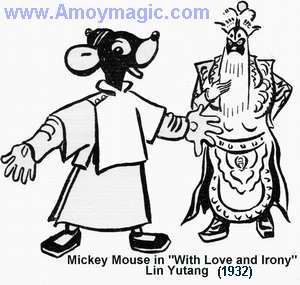
This "Noodle", Lin's God of Chinese Mountains, is taking a lot longer than I thought (two days so far). It will be about my favorite modern Chinese philosopher, Lin Yutang, and why he turned away from God, and how his subsequent study of Chinese classics, and modern Western philosophy and science, led him back to God, and to Christ. Lin's clarity of perception, his logic, and his writing style (what Chinese philosopher would draw a Chinese Mickey Mouse in his book?!) remind me somewhat of C.S. Lewis--except that Lin had the advantage of being thoroughly grounded in both Eastern and Western thought.
I hope to post this in the next day or so. In the meantime, please click here for a brief Lin Yutang biography.
Click here for 林语堂一位“国际化”的中国作家
Lin Yutang Photo Album
Blessings,
Bill
www.amoymagic.com
Monday, March 23, 2009
Little George Changes the World
Bill Brown ... Xiamen University
Passing Torches, Part 2
"But Zion said, "The LORD has forsaken me, the Lord has forgotten me. Can a mother forget the baby at her breast and have no compassion on the child she has borne? Though she may forget, I will not forget you!" Isaiah 49:14, 15

The sickly young black orphan huddling in a stranger's barn probably felt abandoned by God and mankind, but this little child was destined to take up the torch and change the world, thanks to a slave named Libby.
Libby risked beatings to secretly teach other slaves, like Mariah Watkins, how to read. And years later, it was Mariah who found little George sleeping in her barn. He had come to their town to attend school, so she and her husband gave George room and meals in return for doing some chores. When George said he was lucky to have chosen her barn to sleep in, Mariah said, "Luck had nothing to do with it. God brought you to our yard. He has work for you and he wants Andrew and I to help you."
Be Like Libby Mariah told George, "You must learn all you can, then be like Libby." She taught George not only cooking, cleaning, knitting, and crocheting, but also the medicinal uses of herbs and roots. George learned all he could from Mariah, and from any school that would accept him. He eventually became director of Tuskegee Institute's agricultural experimental station. This so-called agricultural station had almost nothing to it (a butter churn, sickly pigs, and worthless land), so George and his students scrounged together whatever they could and built a laboratory from the ground up.
Open my Eyes, Lord Over the next 50 years, George Washington Carver was phenomenally creative, developing hundreds of products [see list at end] from peanuts and other vegetables. Where did he get his ideas? Literally straight from his Father! George rose every morning at 4 a.m. to walk in the woods, pray, and read the old Bible that Mariah had given him. And each morning he prayed, "Open my eyes, Lord, that I may see wonderful things out of your Word." When people asked why he was experimenting on okra, wheat and artichokes, he said, "because God told me to look there." The media and scientists ridiculed this "unscientific" approach, but they could not deny the results.
World Changer. Little George grew up to be adviser to three U.S. Presidents and international leaders like Gandhi, and friends of people like Henry Ford. The first U.S. national monument dedicated to a non-President was the 210-acre George Washington Carver National Monument in Diamond, Missouri, where Carver grew up. When he died, Carver left his life savings to the George Washington Carver Foundation. On his grave is written, "He could have added fortune to fame, but caring for neither, he found happiness and honor in being helpful to the world."
Libby would have been proud.
Passing the Torch. George probably felt abandoned during his sickly youth, but our Father said, "Can a mother forget the baby at her breast? Neither will I forget you." Isa. 49:14 God never forgot George--but he cared for the child through people like Libby, an unknown slave who passed the torch of courage and hope to Mariah, who in turn passed the torch to little George, who passed it on to us.
Who has our Father brought into your life to help you? And whom can you help? Accept the torch, run with it, mount up with wings as eagles [Isaiah 40:31] --and pass it on!
Supplement: Carver's Inventions
Over 300 peanut products, as well as hundreds from sweet potatoes, soybeans, and pecans. They include chili sauce, biofuel, buttermilk, bleach, adhesives, instant coffee, linoleum, mayonnaise, metal polish, meat tenderizer, paper and plastic, shaving cream and shoe polish, wood stain, synthetic rubber, etc. Sweet potatoes yielded 118 potential products, including rubber, 73 dyes, 14 candies, 5 breakfast foods, 5 library pastes, vinegar, coffee, etc. He also published 44 practical bulletins for farmers, and popularized many modern agricultural practices.
Carver's 8 Guidelines
www.amoymagic.com
Passing Torches, Part 2
"But Zion said, "The LORD has forsaken me, the Lord has forgotten me. Can a mother forget the baby at her breast and have no compassion on the child she has borne? Though she may forget, I will not forget you!" Isaiah 49:14, 15

The sickly young black orphan huddling in a stranger's barn probably felt abandoned by God and mankind, but this little child was destined to take up the torch and change the world, thanks to a slave named Libby.
Libby risked beatings to secretly teach other slaves, like Mariah Watkins, how to read. And years later, it was Mariah who found little George sleeping in her barn. He had come to their town to attend school, so she and her husband gave George room and meals in return for doing some chores. When George said he was lucky to have chosen her barn to sleep in, Mariah said, "Luck had nothing to do with it. God brought you to our yard. He has work for you and he wants Andrew and I to help you."
Be Like Libby Mariah told George, "You must learn all you can, then be like Libby." She taught George not only cooking, cleaning, knitting, and crocheting, but also the medicinal uses of herbs and roots. George learned all he could from Mariah, and from any school that would accept him. He eventually became director of Tuskegee Institute's agricultural experimental station. This so-called agricultural station had almost nothing to it (a
 butter churn, sickly pigs, and worthless land), so George and his students scrounged together whatever they could and built a laboratory from the ground up.
Open my Eyes, Lord Over the next 50 years, George Washington Carver was phenomenally creative, developing hundreds of products [see list at end] from peanuts and other vegetables. Where did he get his ideas? Literally straight from his Father! George rose every morning at 4 a.m. to walk in the woods, pray, and read the old Bible that Mariah had given him. And each morning he prayed, "Open my eyes, Lord, that I may see wonderful things out of your Word." When people asked why he was experimenting on okra, wheat and artichokes, he said, "because God told me to look there." The media and scientists ridiculed this "unscientific" approach, but they could not deny the results.
World Changer. Little George grew up to be adviser to three U.S. Presidents and international leaders like Gandhi, and friends of people like Henry Ford. The first U.S. national monument dedicated to a non-President was the 210-acre George Washington Carver National Monument in Diamond, Missouri, where Carver grew up. When he died, Carver left his life savings to the George Washington Carver Foundation. On his grave is written, "He could have added fortune to fame, but caring for neither, he found happiness and honor in being helpful to the world."
Libby would have been proud.
Passing the Torch. George probably felt abandoned during his sickly youth, but our Father said, "Can a mother forget the baby at her breast? Neither will I forget you." Isa. 49:14 God never forgot George--but he cared for the child through people like Libby, an unknown slave who passed the torch of courage and hope to Mariah, who in turn passed the torch to little George, who passed it on to us.
Who has our Father brought into your life to help you? And whom can you help? Accept the torch, run with it, mount up with wings as eagles [Isaiah 40:31] --and pass it on!
Supplement: Carver's Inventions

Over 300 peanut products, as well as hundreds from sweet potatoes, soybeans, and pecans. They include chili sauce, biofuel, buttermilk, bleach, adhesives, instant coffee, linoleum, mayonnaise, metal polish, meat tenderizer, paper and plastic, shaving cream and shoe polish, wood stain, synthetic rubber, etc. Sweet potatoes yielded 118 potential products, including rubber, 73 dyes, 14 candies, 5 breakfast foods, 5 library pastes, vinegar, coffee, etc. He also published 44 practical bulletins for farmers, and popularized many modern agricultural practices.
Carver's 8 Guidelines
- Be clean both inside and out.
- Neither look up to the rich or down on the poor.
- Lose, if need be, without squealing.
- Win without bragging.
- Always be considerate of women, children, and older people.
- Be too brave to lie.
- Be too generous to cheat.
- Take your share of the world and let others take theirs.
www.amoymagic.com
Sunday, March 22, 2009
Passing Torches
Bill Brown ... Xiamen University
 "but those who hope in the LORD will renew their strength. They will soar on wings like eagles; they will run and not grow weary, they will walk and not be faint. " Isaiah 40:31
I was on a FJTV panel when the Beijing Olympics torch was passing through Fujian Province, and I had a photo taken with a girl athlete who carried the torch (she dwarfed me!). Imagine the excitement of carrying a torch with a flame kindled in Athens, but today you and I can run with an even greater torch--the ancient yet ever new torch of life and hope.
Few are honored to carry the Olympic torch, but the torch of life is there for anyone who will receive it--which is perhaps why we take it for granted. But if we do receive it, do we "soar on wings like eagles" and run with it, or do we let our torch sputter and die?
You and I won't be here 100 years from now, but our influence upon future generations can endure--or it can dissipate, like the calligraphy written in the sand beside Xiamen's boardwalk.
Receiving the Torch. Some lives flicker feebly and briefly, and then burn out, because they burn from their own strength. On our own, we are but a candle in the gale. But when our Father fuels our lives, we can blaze bright enough and long enough to touch the lives of others. But the torch is not thrust upon us. We must reach out and receive it, and take responsibility for it until we pass it on.
Refueling the Torch. Like candles and torches, we will burn out unless we keep in contact with the Source, continually refueled through daily prayer (conversation with our Father) and reading his word. As Jesus said in John 15:4, "Remain in me, and I will remain in you. No branch can bear fruit by itself; it must remain in the vine. Neither can you bear fruit unless you remain in me."
We are also refueled by the encouraging words and examples of those whom our Father brings into our lives--and in the same way we must be a light to others.
Passing on the Torch. Like an Olympic torch, our lives blaze for a time, and then we must pass the torch on in the same way in which we received it--by our encouraging example and words. And you never know how a few words may change the life of a person--or even a nation! For example....
J.C., born 1913, was the poor descendant of American slaves, and at age 7 picked up to 100 pounds of cotton a day to help his sharecropping parents. He was sickly, caught pneumonia several times, and almost died twice. His life changed when he moved to Cleveland--and so did his name. His teacher could not understand his country accent so she thought his name was "Jessie," not J.C., and the name stuck.
When the Olympic Champion Charley Paddock spoke to over 1000 students at Jessie's school, he said, "Do you know who you are?...you are children of God. You can be somebody. You can be anything you want to be if you have a goal and will work and believe and have good moral character. You really can be what you want to be with the help of the good God."
The students were electrified, but after the talk, they all went back to class--except Jessie. He stayed behind to thank Paddock, and when they shook hands, Jessie felt an actual spark pass between them. He decided to be an Olympic athlete, and in the end became ever greater than Paddock--though he did not have it easy.
The "3 Ds" Jessie could not practice with the track team after school because he worked, so the coach helped train him before school, making him focus daily on "3 D's": dedication, determination, discipline."

In 1936, the Olympics were held in Berlin. Hitler made fun of the American team for having ten blacks and two Jews, but Jessie Owens set world records and won three gold medals. He then returned to America and took a common job as a playground instructor, where he passed the torch of life and hope to countless children, including Harrison Dillard (the only male to win Olympic medals in both sprinting and hurdling).
One speech and a handshake were enough to pass the torch to Jessie Owens. A caring school coach kept it burning. And then Jessie passed it on.
Take up the torch, run with it, and then pass it on!
Note: Flame or Smoke? Jessie Owens died at age 66 of lung cancer. Like many poor children, he'd taken up smoking early, and smoked his entire life. Don't be a smoking torch but a blazing torch!
www.amoymagic.com
 "but those who hope in the LORD will renew their strength. They will soar on wings like eagles; they will run and not grow weary, they will walk and not be faint. " Isaiah 40:31
I was on a FJTV panel when the Beijing Olympics torch was passing through Fujian Province, and I had a photo taken with a girl athlete who carried the torch (she dwarfed me!). Imagine the excitement of carrying a torch with a flame kindled in Athens, but today you and I can run with an even greater torch--the ancient yet ever new torch of life and hope.
Few are honored to carry the Olympic torch, but the torch of life is there for anyone who will receive it--which is perhaps why we take it for granted. But if we do receive it, do we "soar on wings like eagles" and run with it, or do we let our torch sputter and die?
You and I won't be here 100 years from now, but our influence upon future generations can endure--or it can dissipate, like the calligraphy written in the sand beside Xiamen's boardwalk.
Receiving the Torch. Some lives flicker feebly and briefly, and then burn out, because they burn from their own strength. On our own, we are but a candle in the gale. But when our Father fuels our lives, we can blaze bright enough and long enough to touch the lives of others. But the torch is not thrust upon us. We must reach out and receive it, and take responsibility for it until we pass it on.
Refueling the Torch. Like candles and torches, we will burn out unless we keep in contact with the Source, continually refueled through daily prayer (conversation with our Father) and reading his word. As Jesus said in John 15:4, "Remain in me, and I will remain in you. No branch can bear fruit by itself; it must remain in the vine. Neither can you bear fruit unless you remain in me."
We are also refueled by the encouraging words and examples of those whom our Father brings into our lives--and in the same way we must be a light to others.
Passing on the Torch. Like an Olympic torch, our lives blaze for a time, and then we must pass the torch on in the same way in which we received it--by our encouraging example and words. And you never know how a few words may change the life of a person--or even a nation! For example....
J.C., born 1913, was the poor descendant of American slaves, and at age 7 picked up to 100 pounds of cotton a day to help his sharecropping parents. He was sickly, caught pneumonia several times, and almost died twice. His life changed when he moved to Cleveland--and so did his name. His teacher could not understand his country accent so she thought his name was "Jessie," not J.C., and the name stuck.
When the Olympic Champion Charley Paddock spoke to over 1000 students at Jessie's school, he said, "Do you know who you are?...you are children of God. You can be somebody. You can be anything you want to be if you have a goal and will work and believe and have good moral character. You really can be what you want to be with the help of the good God."
The students were electrified, but after the talk, they all went back to class--except Jessie. He stayed behind to thank Paddock, and when they shook hands, Jessie felt an actual spark pass between them. He decided to be an Olympic athlete, and in the end became ever greater than Paddock--though he did not have it easy.
The "3 Ds" Jessie could not practice with the track team after school because he worked, so the coach helped train him before school, making him focus daily on "3 D's": dedication, determination, discipline."

In 1936, the Olympics were held in Berlin. Hitler made fun of the American team for having ten blacks and two Jews, but Jessie Owens set world records and won three gold medals. He then returned to America and took a common job as a playground instructor, where he passed the torch of life and hope to countless children, including Harrison Dillard (the only male to win Olympic medals in both sprinting and hurdling).
One speech and a handshake were enough to pass the torch to Jessie Owens. A caring school coach kept it burning. And then Jessie passed it on.
Take up the torch, run with it, and then pass it on!
Note: Flame or Smoke? Jessie Owens died at age 66 of lung cancer. Like many poor children, he'd taken up smoking early, and smoked his entire life. Don't be a smoking torch but a blazing torch!
www.amoymagic.com
Thursday, March 19, 2009
Stormy Lake or Still, Small Voice?
Bill Brown ... Xiamen University
"Let us go over to the other side." Mark 4:35
What a vivid scene--Jesus sound asleep in a tiny boat tossing in a storm, and the disciples yelling, "Teacher, don't you care if we drown?" Jesus sat up, rebuked the wind and waves, and asked, "Why are you afraid? Do you still have no faith?" Mark 4:41 NIV
1. The Parables Jesus asked, "Are you "still" afraid?" because he had spent the entire day teaching a crowd so large that he had to preach from a boat. Mark said that Jesus taught "as much as the crowd could understand", but he only used parables. By speaking indirectly, he left it open to his listeners to accept or reject as much as they were ready for--but even his own disciples did not understand the parables.
2. The Theory. Mark 4:34 says, "But when he was alone with his own disciples, he explained everything." Imagine listening to Jesus for an entire day, and then having him explain further, one-on-one. And he finished the day with the powerful analogy of a mustard seed (in another passage, he said that faith even as small as a mustard seed could move mountains). I'm sure the disciples sat enthralled, and said the obligatory "Yeah, Lord!", "Amen," etc. But obviously it was just in their heads, not their hearts, because after a long, tiring day of teaching, Jesus said, "Let us go over to the other side."
3. Crossing the Lake. I can just imagine Jesus smiling to himself as the disciples set sail across the lake. Jesus went to sleep, the storm hit--and you know the rest. If Jesus had power over wind and waves, certainly he also knew, as did the simplest fisherman, that evening squalls were common on the Sea of Galilee?. But Jesus did not wait until morning because he knew that an entire day of teaching, followed by one-on-one explanations, had still not got his message across to his hard-headed disciples. They had dry head knowledge but no practical heart belief, so Jesus let them put the theory into practice (which, unfortunately, is often the only way we can learn).
4. Storm or Silence. The disciples could have been spared the terrifying lake crossing had they really listened to and believed Jesus' message. We, too, choose daily how we will learn. We can learn from that still, small voice within us, or we can ignore Him, and force our Father to plop us down in a small boat in a stormy lake to get our attention.
5. The Other Side. After Jesus quieted the wind and waves, the disciples exclaimed, " "Who is this? Even the wind and the waves obey him!" Mark 4:41 NIV. But while wind and waves obey, we often do not. We can choose to learn at his feet, or we can cross the stormy lake. Fortunately, if He does tell us to cross a stormy lake, we know that He will also take us to the other side.
And if we foolishly decide to cross a stormy lake on our own initiative, for our own purposes, well, that's another Noodle...
www.amoymagic.com
"Let us go over to the other side." Mark 4:35
What a vivid scene--Jesus sound asleep in a tiny boat tossing in a storm, and the disciples yelling, "Teacher, don't you care if we drown?" Jesus sat up, rebuked the wind and waves, and asked, "Why are you afraid? Do you still have no faith?" Mark 4:41 NIV
1. The Parables Jesus asked, "Are you "still" afraid?" because he had spent the entire day teaching a crowd so large that he had to preach from a boat. Mark said that Jesus taught "as much as the crowd could understand", but he only used parables. By speaking indirectly, he left it open to his listeners to accept or reject as much as they were ready for--but even his own disciples did not understand the parables.
2. The Theory. Mark 4:34 says, "But when he was alone with his own disciples, he explained everything." Imagine listening to Jesus for an entire day, and then having him explain further, one-on-one. And he finished the day with the powerful analogy of a mustard seed (in another passage, he said that faith even as small as a mustard seed could move mountains). I'm sure the disciples sat enthralled, and said the obligatory "Yeah, Lord!", "Amen," etc. But obviously it was just in their heads, not their hearts, because after a long, tiring day of teaching, Jesus said, "Let us go over to the other side."
3. Crossing the Lake. I can just imagine Jesus smiling to himself as the disciples set sail across the lake. Jesus went to sleep, the storm hit--and you know the rest. If Jesus had power over wind and waves, certainly he also knew, as did the simplest fisherman, that evening squalls were common on the Sea of Galilee?. But Jesus did not wait until morning because he knew that an entire day of teaching, followed by one-on-one explanations, had still not got his message across to his hard-headed disciples. They had dry head knowledge but no practical heart belief, so Jesus let them put the theory into practice (which, unfortunately, is often the only way we can learn).
4. Storm or Silence. The disciples could have been spared the terrifying lake crossing had they really listened to and believed Jesus' message. We, too, choose daily how we will learn. We can learn from that still, small voice within us, or we can ignore Him, and force our Father to plop us down in a small boat in a stormy lake to get our attention.
5. The Other Side. After Jesus quieted the wind and waves, the disciples exclaimed, " "Who is this? Even the wind and the waves obey him!" Mark 4:41 NIV. But while wind and waves obey, we often do not. We can choose to learn at his feet, or we can cross the stormy lake. Fortunately, if He does tell us to cross a stormy lake, we know that He will also take us to the other side.
And if we foolishly decide to cross a stormy lake on our own initiative, for our own purposes, well, that's another Noodle...
www.amoymagic.com
Wednesday, March 18, 2009
Ancient Crossroads
Bill B. Xiamen University
"This is what the LORD says: "Stand at the crossroads and look; ask for the ancient paths, ask where the good way is, and walk in it, and you will find rest for your souls. But you said, 'We will not walk in it.'" Jer 6:16
"I took the one less traveled by. And that has made all the difference." Robert Frost.
Years ago, while climbing "Five Old Men Peaks" behind Nanputuo Temple with my son, who was eight then, we came to a fork in the pathway and I asked, "Which way?" When Shannon pointed to the right, I asked why, and he said, "It goes up. Up is always more fun."
Each morning we stand at a new crossroad in life. Do our decisions take us up--or down? What should I study in college, and where? Should I marry, and when? Should I go to English Corner or stay home and sleep?
Most day-to-day decisions seem trivial, but over the decades they are the small steps that complete the "1,000 mile journey" we call life. Do our daily decisions lift us up or lead us downward? Bring us closer to our goal, or further from it? And how do we make our decisions?
In "The Art of War," Sunzi said to, "Know yourself." What goals, motives, priorities and values direct our decisions? Do we base our decisions solely on our own experience, and the short-term benefits, or do we seek wisdom to make decisions that reinforce the unique purpose of our own lives. In Jeremiah 6, Jerusalem was urged to:
1. "Stand at the crossroads and look." How many times do we race through the crossroads without even thinking about alternative paths? We already know what we want, and we just go for it, blind to other options, and sometimes we must retrace our steps with our tails between our legs.
2. "Ask for the ancient paths, ask where the good way is." If I were walking through swamps of quicksand, I'd rather follow a reliable map than chance getting sucked under. Fortunately, though life can seem like a swamp of quicksand, we have both a map and a Personal Guide to help us get through it. The swamp shifts daily, but the Ancient Paths and the One who guides us through them do not. The basic principles for how to live, rather than just get through life, are recorded clearly in our Father's Word, but a good example is always better than a lecture, so He also sent his Son to show us, firsthand, how to live.
3. "Walk in it and you will find rest for your souls." It is not enough to just know the path; we must walk in it. We will not be carried. We must rise daily, look at the crossroad, discern the Ancient Path--and then lace up our hiking shoes and walk.
Follow the Crowd or Keep the Course? We can live each day deliberately, with direction and purpose, or we can wander aimlessly, without direction--like the vast majority of people on our little planet. No wonder Jesus said, "Enter through the narrow gate. For wide is the gate and broad is the road that leads to destruction, and many enter through it. But small is the gate and narrow the road that leads to life, and only a few find it." Matt. 7:13,14
The path to failure was widened not by God but by the countless people trampling blindly down it. The road to life and purpose is narrow only because so few people choose it. But both paths, the wide and the narrow, are before each of us daily. We can choose the Ancient Path--or we can refuse. As Jeremiah said of Jerusalem, which persisted in going its own way, "But you said, 'We will not walk in it.'" Jer. 6:16
Today we face yet another Crossroads. Don't rush through that crossroads blindly. Stop, look, seek wisdom, and then follow the Ancient Path that is the surest route to purpose, fulfillment and joy.
The following story about Shannon was adapted from "Magic Xiamen--Guide to Xiamen").
Look UP! On a crisp November morning, Susan and Matthew went shopping and Shannon and I took the road less traveled—the trail up the mountain behind Nánputuó Temple and monastery, past the sign that says “No foreigners beyond this sign,” and over the crest.
We drank deeply of the silence as we picked our way over damp boulders covered in lichen. We waded through ferns, and ducked beneath the grayish green moss covered branches. At times I sunk into reverie, imagining that we were blazing trails where no man had gone before. And every time, I was rudely yanked back into reality by the sight of Chinese characters carved deeply into the granite cliffs by ancient poets seeking immortality with a hammer and chisel centuries before Eric the Red took up real estate in Greenland.
I paused at one fork (or maybe a chopstick) in the path and asked Shannon, “Which way?”
“Up!” he said.
“Why up?” I asked.
“Because up is more fun," Shannon said.
It takes a decade or more for children to unlearn their inborn inclination to climb. By adulthood, many no longer know which way is up, or care. Yet there lingers a memory of Up, and a vague discontent for which we compensate by looking out, or in, but seldom Up. As Thoreau put it,
“We seem but to linger in manhood to tell the dreams of our childhood, and they vanish out of memory ere we learn the language.”
"What is man that you are mindful of him...You have made him a little lower than the heavenly beings... You made him ruler over the works of your hands..." Psalm 8:4-6
I suspect that children are a different species, a little lower than the angels and a little higher than man, given us that we may rediscover childhood’s marvelous mix of ambition tempered with contentment. Of such is the kingdom.
Shannon and I sat on the sun-baked granite summit of the Five Old Men Mountains behind Nanputuo Temple, and I penned in my notebook,
UP
The simplest seed, entombed
ignobly on its noggin,
impugns the claims of gravity
and turning, strives to gain
the unseen sun.
Bill B. (Nov. 1997)
Life’s magic lies in looking up!
Of course, in China at least, when lo0king up, watch where you're walking.
www.amoymagic.com
"This is what the LORD says: "Stand at the crossroads and look; ask for the ancient paths, ask where the good way is, and walk in it, and you will find rest for your souls. But you said, 'We will not walk in it.'" Jer 6:16
"I took the one less traveled by. And that has made all the difference." Robert Frost.
Years ago, while climbing "Five Old Men Peaks" behind Nanputuo Temple with my son, who was eight then, we came to
 a fork in the pathway and I asked, "Which way?" When Shannon pointed to the right, I asked why, and he said, "It goes up. Up is always more fun."
Each morning we stand at a new crossroad in life. Do our decisions take us up--or down? What should I study in college, and where? Should I marry, and when? Should I go to English Corner or stay home and sleep?
Most day-to-day decisions seem trivial, but over the decades they are the small steps that complete the "1,000 mile journey" we call life. Do our daily decisions lift us up or lead us downward? Bring us closer to our goal, or further from it? And how do we make our decisions?
In "The Art of War," Sunzi said to, "Know yourself." What goals, motives, priorities and values direct our decisions? Do we base our decisions solely on our own experience, and the short-term benefits, or do we seek wisdom to make decisions that reinforce the unique purpose of our own lives. In Jeremiah 6, Jerusalem was urged to:
1. "Stand at the crossroads and look." How many times do we race through the crossroads without even thinking about alternative paths? We already know what we want, and we just go for it, blind to other options, and sometimes we must retrace our steps with our tails between our legs.
2. "Ask for the ancient paths, ask where the good way is." If I were walking through swamps of quicksand, I'd rather follow a reliable map than chance getting sucked under. Fortunately, though life can seem like a swamp of quicksand, we have both a map and a Personal Guide to help us get through it. The swamp shifts daily, but the Ancient Paths and the One who guides us through them do not. The basic principles for how to live, rather than just get through life, are recorded clearly in our Father's Word, but a good example is always better than a lecture, so He also sent his Son to show us, firsthand, how to live.
3. "Walk in it and you will find rest for your souls." It is not enough to just know the path; we must walk in it. We will not be carried. We must rise daily, look at the crossroad, discern the Ancient Path--and then lace up our hiking shoes and walk.
Follow the Crowd or Keep the Course? We can live each day deliberately, with direction and purpose, or we can wander aimlessly, without direction--like the vast majority of people on our little planet. No wonder Jesus said, "Enter through the narrow gate. For wide is the gate and broad is the road that leads to destruction, and many enter through it. But small is the gate and narrow the road that leads to life, and only a few find it." Matt. 7:13,14
The path to failure was widened not by God but by the countless people trampling blindly down it. The road to life and purpose is narrow only because so few people choose it. But both paths, the wide and the narrow, are before each of us daily. We can choose the Ancient Path--or we can refuse. As Jeremiah said of Jerusalem, which persisted in going its own way, "But you said, 'We will not walk in it.'" Jer. 6:16
Today we face yet another Crossroads. Don't rush through that crossroads blindly. Stop, look, seek wisdom, and then follow the Ancient Path that is the surest route to purpose, fulfillment and joy.
The following story about Shannon was adapted from "Magic Xiamen--Guide to Xiamen").
Look UP! On a crisp November morning, Susan
 and Matthew went shopping and Shannon and I took the road less traveled—the trail up the mountain behind Nánputuó Temple and monastery, past the sign that says “No foreigners beyond this sign,” and over the crest.
We drank deeply of the silence as we picked our way over damp boulders covered in lichen. We waded through ferns, and ducked beneath the grayish green moss covered branches. At times I sunk into reverie, imagining that we were blazing trails where no man had gone before. And every time, I was rudely yanked back into reality by the sight of Chinese characters carved deeply into the granite cliffs by ancient poets seeking immortality with a hammer and chisel centuries before Eric the Red took up real estate in Greenland.
I paused at one fork (or maybe a chopstick) in the path and asked Shannon, “Which way?”
“Up!” he said.
“Why up?” I asked.
“Because up is more fun," Shannon said.
It takes a decade or more for children to unlearn their inborn inclination to climb. By adulthood, many no longer know which way is up, or care. Yet there lingers a memory of Up, and a vague discontent for which we compensate by looking out, or in, but seldom Up. As Thoreau put it,
“We seem but to linger in manhood to tell the dreams of our childhood, and they vanish out of memory ere we learn the language.”
"What is man that you are mindful of him...You have made him a little lower than the heavenly beings... You made him ruler over the works of your hands..." Psalm 8:4-6
I suspect that children are a different species, a little lower than the angels and a little higher than man, given us that we may rediscover childhood’s marvelous mix of ambition tempered with contentment. Of such is the kingdom.
Shannon and I sat on the sun-baked granite summit of the Five Old Men Mountains behind Nanputuo Temple, and I penned in my notebook,
UP
The simplest seed, entombed
ignobly on its noggin,
impugns the claims of gravity
and turning, strives to gain
the unseen sun.
Bill B. (Nov. 1997)
Life’s magic lies in looking up!
Of course, in China at least, when lo0king up, watch where you're walking.
www.amoymagic.com
Subscribe to:
Posts (Atom)

 Posts
Posts


